
Manganese in well water shows up as black stains on tubs, laundry and ice cubes once it passes about 0.05 mg/L, and it needs a different removal system than iron does, because manganese oxidizes more slowly and needs a higher pH before a filter can catch it. The right system depends on three numbers from the same lab report: how much manganese is present, how much iron rides along with it, and what the pH reads. I am not a licensed water treatment professional, so treat the ranges below as a way to read your own report, not a purchase decision to make without one.
At a glance
- 0.05 mg/L is the EPA secondary limit for manganese, and the point where black staining usually starts
- pH 7.5 is the floor a Birm oxidizing filter needs before it removes manganese; iron alone only needs 6.8
- 3 to 10 mg/L combined iron and manganese is the range manganese greensand is built for; above that, chemical injection takes over
- A water softener is sized around hardness and iron, not manganese, so it is a helper here, never the fix
In this guide
- What manganese in well water actually looks like
- Why the fix for iron does not automatically cover manganese
- Reading your lab report against the treatment thresholds
- Water softeners: a hardness fix, not a manganese fix
- Oxidizing filters: Birm and manganese greensand
- When manganese calls for chemical injection instead
- What reverse osmosis can and cannot do about manganese
- The health question a filter salesperson will not answer precisely
- Confirming the fix worked, not just that the stain stopped
What manganese in well water actually looks like
Iron rust stains run orange or reddish-brown. Manganese does the same job in black to gray-black, on the same fixtures: toilet tanks, the underside of a dishwasher rack, the ice from a refrigerator line, and dark speckling on white laundry that will not bleach out. The EPA’s secondary standard, the aesthetic threshold rather than a health-based one, sits at 0.05 mg/L, a small fraction of the 0.3 mg/L secondary limit for iron. That gap matters: a well can read comfortably under the iron limit and still stain black, because manganese trips its own limit at a much lower concentration.
Manganese and iron come from the same rock and soil chemistry and usually show up together on a well report, which is why most guidance treats them as a pair rather than two separate problems. They are not identical problems, though. Manganese oxidizes more slowly than iron, needs a higher pH to convert into a solid a filter can trap, and coats plumbing and treatment media harder to strip back off once it builds up. A system sized purely on the iron number can leave the manganese line on your report untouched.
Why the fix for iron does not automatically cover manganese
Every removal method for either metal runs on the same idea: turn the dissolved form into a solid particle, then catch the particle in a filter bed. The step that trips people up is the first one, oxidation, and manganese is pickier about the conditions it needs than iron is.
- pH. Iron oxidizes on a Birm-type filter starting around pH 6.8. Manganese needs the water at pH 7.5 or higher on the same media, per Penn State Extension’s guidance for private water systems. A well that clears iron just fine at pH 7.0 can still pass manganese straight through.
- Concentration. Penn State’s guidance places manganese greensand filters in the 3 to 10 mg/L range for combined iron and manganese, and points to chemical oxidation ahead of a filter once that combined total runs past 10 mg/L.
- Form. A softener’s resin only handles metals still in dissolved (ferrous or Mn2+) form. Anything already oxidized by contact with air, an aerator, or a pressure tank coats the resin instead of exchanging off it, and stops working within weeks rather than years.
Reading your lab report against the treatment thresholds
The three numbers you need are already on a standard well test: iron, manganese, and pH. Here is how they translate into a decision, using an example report rather than your actual numbers.
Example lab report, worked through the thresholds
lab report: iron = 0.4 mg/L, manganese = 0.15 mg/L, pH = 7.2
combined Fe+Mn = 0.55 mg/L -> well under the 3-10 mg/L greensand range
Birm needs pH >= 7.5 for manganese, >= 6.8 for iron
7.2 is above the iron floor but below the manganese floor
result: iron would clear, manganese would mostly pass through
fix: raise pH first (acid neutralizer or a chemical feed), or
     choose chemical injection, which oxidizes ahead of the filter
     instead of leaning on pH alone
That 0.4 mg/L iron and 0.15 mg/L manganese combination would look almost fine on a report scanned only against the iron limit. It is the manganese line, read against its own pH requirement rather than iron’s, that changes the answer. Before sizing anything, get a current lab report rather than the one from closing day, because pH drifts with the seasons and an old number can send you shopping for the wrong system.
Water softeners: a hardness fix, not a manganese fix
A conventional water softener is specified around hardness and iron, not manganese. Penn State’s guidance for when a softener can still handle metals at all sets three conditions together: pH above 6.7, hardness between 3 and 20 grains per gallon (50 to 350 mg/L), and dissolved iron under 5 mg/L. Manganese does not appear in that specification at all, which is the point: softeners were never rated against it the way they are rated against hardness and iron.
In practice, a softener pulls out a little dissolved manganese as a side effect of exchanging other cations, as long as the manganese has not already oxidized. Once it has, or once the concentration climbs past trace levels, the resin coats and its capacity for hardness starts dropping too, on a resin bed that was never rated for the job. A well running only trace manganese alongside hardness may need nothing more than a well-sized softener, checked against a report every year or two. Anything past a trace reading is better treated ahead of the softener, not by it, which is the same logic that applies to iron above 0.3 mg/L on a dedicated iron filter rather than the softening resin.
Oxidizing filters: Birm and manganese greensand
These are the two backwashing media families built specifically for iron and manganese, and the difference between them is mostly about how the oxidation happens.
Birm relies on dissolved oxygen already in the water to do the oxidizing, which is why it needs no chemical feed and no regeneration, only a periodic backwash to flush the trapped solids. Its tradeoff is the pH floor: 6.8 for iron, 7.5 for manganese, with no chlorine or other oxidizer allowed ahead of it, since that strips the catalytic coating off the media over time.
Manganese greensand carries its own oxidizer, a potassium permanganate coating that gets replenished on a regeneration cycle much like a softener recharges with salt. Penn State’s guidance places it in the 3 to 10 mg/L combined iron-and-manganese range, wider than Birm’s comfort zone and less dependent on getting the pH exactly right first, at the cost of a regeneration chemical to manage and a media bed that needs replacing eventually rather than lasting indefinitely.
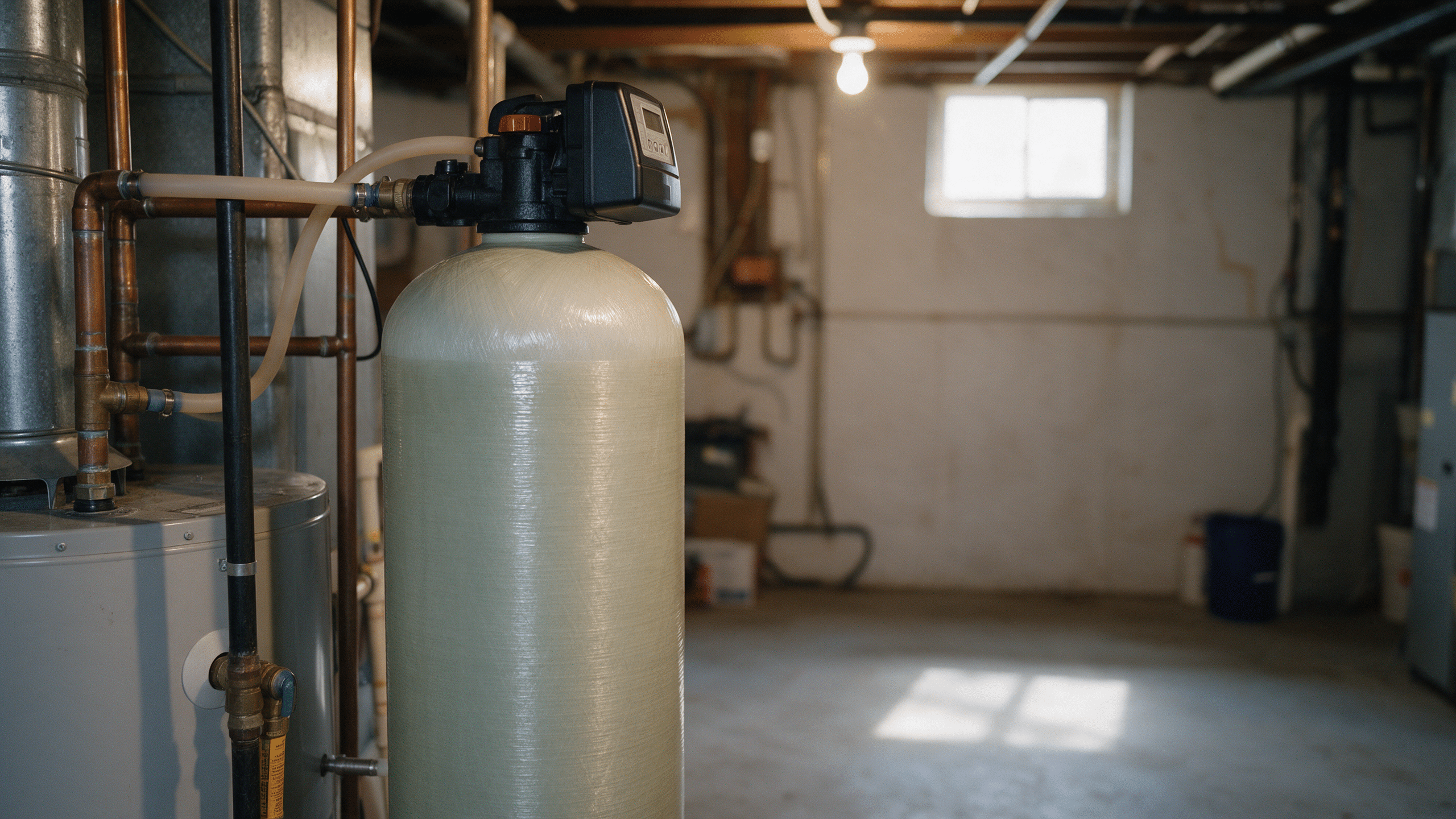
When manganese calls for chemical injection instead
Past roughly 10 mg/L combined iron and manganese, Penn State’s guidance moves past media-only oxidation and into chemical injection: a metering pump feeds chlorine, potassium permanganate, or hydrogen peroxide ahead of a contact tank, giving the oxidizer time to work before a mechanical filter catches the resulting solids. Because the chemical does the oxidizing rather than the media or the water’s own pH, it is less fussy about the exact pH reading than Birm is, which is also why it is the fallback when a straight oxidizing filter is not clearing a stubborn well.
The tradeoff is real plumbing, not a drop-in tank. A chlorine feed needs a contact tank sized for enough dwell time to finish the reaction, and an activated carbon filter afterward to strip the chlorine taste back out before it reaches a faucet. It is more to install, more to maintain, and more that can go wrong than a backwashing filter alone, which is exactly why it is reserved for the concentration range where the simpler options stop being enough.
Where oxidizing filters earn their keep
- Treat every fixture in the house, not just one tap
- Birm needs no chemical and no regeneration once the pH is right
- Greensand covers a wider concentration range without a separate pH-correction step first
- Both run unattended between backwash or regeneration cycles
Where they disappoint
- Birm stops working the moment pH drops below its floor, with no warning on the tap
- Greensand needs a permanganate regenerant to keep buying and dosing correctly
- Neither corrects hardness, so a separate softener may still be needed
- Undersized media on a high-flow house lets water pass through before oxidation finishes
What reverse osmosis can and cannot do about manganese
A point-of-use reverse osmosis unit under the kitchen sink will pull dissolved manganese out of the water it treats, which is why it shows up as a fallback in most treatment guidance. What it will not do is protect the rest of the house. RO treats one faucet at whatever flow rate the membrane allows, so the water heater, the washing machine, and every other tap keep receiving whatever the well is delivering, stains and all. Comparing a point fix like RO against a whole-house disinfection approach makes more sense once you know whether the problem is really a single tap’s drinking water or the plumbing at large.
RO earns its place as a second layer, not a replacement for whole-house treatment, when the household wants an extra margin on drinking and cooking water specifically, on top of an oxidizing filter or chemical injection system handling the rest of the house.
The health question a filter salesperson will not answer precisely
EPA classifies manganese under its secondary, aesthetic standards, the same category as iron, TDS, and hardness, meaning the 0.05 mg/L limit is about staining and taste rather than an enforceable health rule. That is not the same as “no health question exists.” EPA’s own reference materials cite a manganese health advisory of 0.3 mg/L, and several state health departments publish their own guidance specifically for infants: the Minnesota Department of Health, for one, advises 100 micrograms per liter (0.1 mg/L) or less in water used for infant formula, and 300 micrograms per liter (0.3 mg/L) or less for everyone else. These are guidance values from individual agencies, not a single federal rule, and they are not the same figure everywhere.
None of that adds up to a diagnosis, and this is not a substitute for one. If there is an infant in the house, or a pregnancy, and a lab report shows manganese anywhere near these guidance levels, that is a conversation for a pediatrician and the state or county health department, not a treatment company running a free in-home test on the side of selling equipment.
Confirming the fix worked, not just that the stain stopped
A stain that fades is not proof the manganese number moved. Oxidizing media can strip particles down without pushing the dissolved reading anywhere near zero, especially in the first weeks after a pH correction or a new regeneration schedule beds in. Retest the same panel that flagged the problem, at the same lab if possible, 60 to 90 days after any new equipment goes in, then fold that result back into the same annual testing routine that caught it in the first place. A single pass or fail a few months after installation tells you less than watching the number for a year.
| Method | Works best at | pH needed | Main limitation |
|---|---|---|---|
| Water softener | Trace manganese only, alongside hardness and iron under 5 mg/L | Above 6.7 | Not rated for manganese; fouls once levels or oxidation state rise |
| Birm filter | Iron-led wells with manganese in check | 6.8 for iron, 7.5 for manganese | No chemical feed allowed ahead of it; strict pH floor |
| Manganese greensand | 3 to 10 mg/L combined iron and manganese | Wider tolerance than Birm | Needs regular permanganate regeneration |
| Chemical injection | Above 10 mg/L combined, or unreliable pH | Not pH-dependent | Contact tank plus carbon filter to remove afterward |
| Point-of-use RO | One tap’s drinking and cooking water | Not applicable | Does nothing for the rest of the plumbing |
Is manganese in well water dangerous?
EPA regulates manganese as a secondary, aesthetic standard at 0.05 mg/L, mainly for staining and taste rather than as an enforceable health rule, though EPA reference material also cites a 0.3 mg/L health advisory. Several state health departments publish separate, lower guidance for infant formula. Treat any result near those levels as a reason to talk to a pediatrician or your local health department, not as a question a filter can answer on its own.
Will a water softener remove manganese from well water?
Only a little, and only while the manganese is still dissolved. Softeners are specified around hardness and iron, not manganese, and Penn State Extension’s own conditions for when a softener works at all do not mention a manganese threshold. Once manganese has oxidized or climbs past a trace amount, treat it ahead of the softener instead of expecting the softener to catch it.
What is the best filter for manganese in well water?
There is no single best filter; the right one depends on your combined iron-and-manganese reading and your pH. Birm suits iron-led wells with pH at or above 7.5, manganese greensand covers a 3 to 10 mg/L combined range with less pH sensitivity, and anything above 10 mg/L combined typically needs chemical injection ahead of a filter.
Why does my water stain black instead of orange?
Orange and reddish stains are iron. Black to gray-black staining, especially on toilet tanks, ice, and laundry, points to manganese, which trips its own EPA secondary limit of 0.05 mg/L, well below the 0.3 mg/L limit for iron. A well can pass the iron limit comfortably and still stain black from manganese alone.


